
Villa Interior Design · Dubai
Modern Villa Design Ideas for Dubai Homes in 2026
What's actually changing in villa interiors across Dubai this year, and how to apply it without ending up with a house that looks like a hotel lobby.
The short version
Modern villa design in Dubai for 2026 favours warm, textured minimalism over stark white interiors: honed travertine, fluted timber, brushed brass and large glazing, carried across three or four finishes rather than ten, with daylight and layout doing more of the work than decoration.
Modern villa design in Dubai this year is moving away from stark white minimalism and cold, polished marble. What's replacing it is warmer and more textured: honed stone in sandy tones, fluted timber panelling, brushed brass, and glazing large enough to blur the line between inside and outside. It's still restrained. It just isn't sterile anymore.
We've worked on villas across Emirates Hills, Al Barari and Dubai Hills Estate this year, and the brief is almost always some version of the same thing: something that photographs well but doesn't feel like a showroom nobody actually lives in. If you want to see how that plays out in practice rather than in theory, take a look at our villa interior design in Dubai portfolio, which shows the range, from full-height glazed courtyards to quieter, more textural interiors built around one or two statement materials.
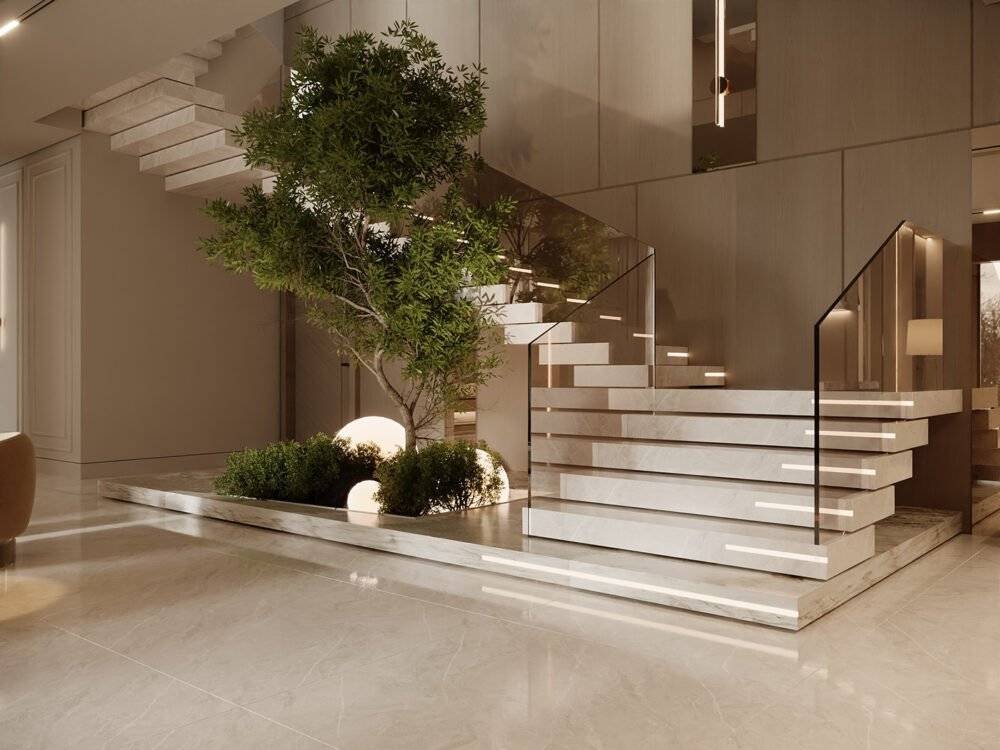
What actually makes a villa feel "modern" in Dubai right now?
A modern villa in Dubai right now means clean lines, a tight material palette, and daylight treated as the main design feature instead of an afterthought. Three or four finishes carried consistently through a home read as considered. Ten finishes read as indecisive, no matter how expensive each one is.
In practice that means low-slung furniture instead of anything ornate, fewer internal partitions so rooms breathe into each other, flush skirting and hidden door frames so the architecture stays quiet, and storage that disappears into panelling rather than sitting as furniture. The goal isn't emptiness. It's control. Every surface earns its place.
Should a modern villa still include Arabic design elements?
Plenty of our clients want both, and there's no rule that says modern has to mean stripped of local character. A geometric screen inspired by mashrabiya patterns, reworked in powder-coated metal instead of carved wood, does real work: it filters harsh afternoon light, adds privacy at street-facing windows, and reads as unmistakably regional without tipping into pastiche. Arched openings, reinterpreted as a single soft curve rather than a full horseshoe arch, do something similar in a hallway or a majlis threshold.
The two approaches sit closer together than most people assume, and where exactly they overlap or pull apart is worth understanding before you brief a designer either way. We've written a full breakdown in modern versus Arabic villa design, if you're genuinely weighing the two rather than defaulting to one.
What materials are actually showing up in 2026 villa projects?
A handful of finishes keep repeating across the villas we've delivered this year, and it's worth naming them plainly rather than in vague trend language:
- Honed travertine and limestone, matte rather than polished, on floors, stair treads and feature walls
- Fluted oak or walnut panelling used sparingly on one wall, usually behind a TV unit or staircase, not wrapped around an entire room
- Micro-cement flooring for a seamless, joint-free look through open-plan living areas
- Brushed brass or bronze ironmongery on door handles, tap fittings and light fixtures, warmer than chrome and more forgiving of fingerprints
- Boucle and linen upholstery instead of leather, which tends to read heavier and hotter in a Gulf climate
None of these are exotic or hard to source in the UAE. What separates a considered result from a showroom mashup is restraint: picking two or three of these and carrying them through consistently, rather than sampling all five in one living room.
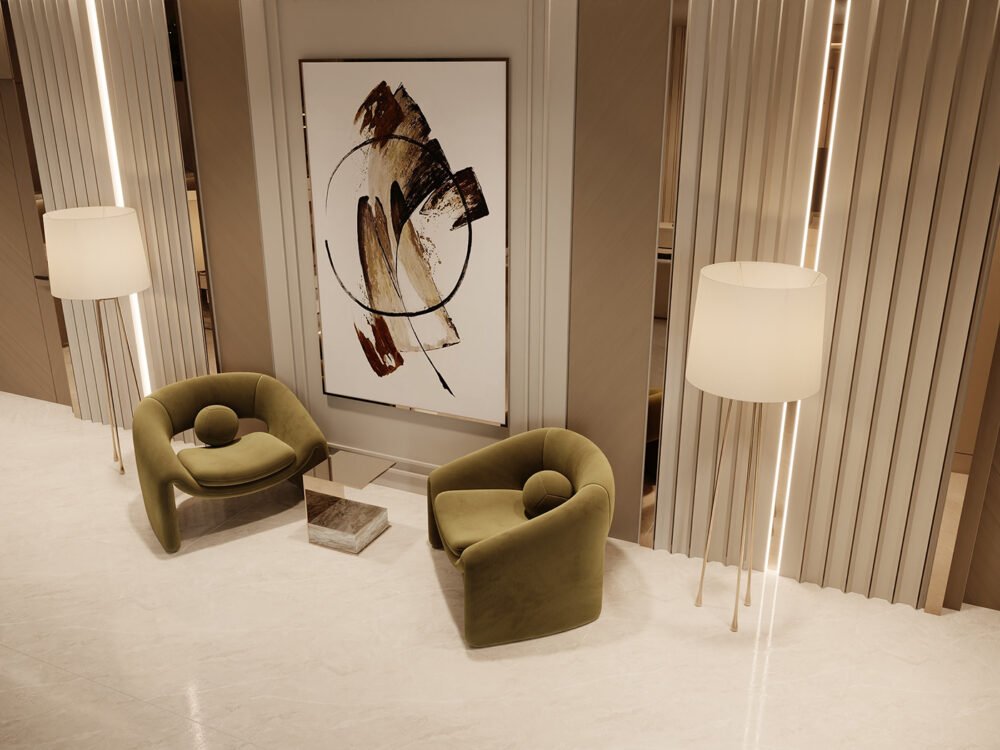
"The mistake we see most often isn't a bad material choice, it's too many good ones fighting for attention in the same room."
Layla Haddad, Senior Interior Designer at Enzo InteriorsHow do you handle Dubai's light and heat without losing the look?
Large glazing is central to the modern villa aesthetic, and it's also the single biggest thermal liability in this climate if it's not planned properly. The fix isn't smaller windows. It's controlling what the glass faces and what sits in front of it.
Deep roof overhangs, motorized external screens on west and south-facing glazing, and a landscaped buffer of trees or a shaded courtyard between the house and direct sun all let you keep full-height glass without turning a living room into a greenhouse by 3pm. We also orient the largest openings toward internal courtyards or shaded gardens wherever the plot allows, so the most dramatic sightlines aren't also the ones taking the worst afternoon heat.
What does a modern open-plan villa layout actually look like?
The most common request we get is an open kitchen, living and dining space treated as one continuous volume, with a separate, closable snug or study nearby for anyone who actually wants quiet. The formal majlis, where Emirati or Arab families are entertaining guests, tends to stay a distinct room rather than folding into the open plan. It's one of the few areas where separation still makes sense.
Utility spaces, laundry, staff areas, plant rooms, get pushed fully out of sightlines and behind matching panelled doors rather than tucked awkwardly off the kitchen. It's a small decision that has an outsized effect on how "finished" a home feels day to day.
Which Dubai communities are leaning into this style hardest?
We see slightly different appetites depending on the community, and it's worth knowing which one you're building or renovating in before you commit to a direction:
- Emirates Hills: larger footprints support dramatic double-height entries and full-height glazing without the proportions feeling forced
- Al Barari: heavily landscaped plots suit a more biophilic, nature-forward material mix, timber and stone leaning warmer than elsewhere
- Dubai Hills Estate: newer, often blank-canvas builds see the highest share of clients asking for a fully modern treatment with no traditional cues at all
- Tilal Al Ghaf and Arabian Ranches: slightly more transitional appetite, modern lines with warmer, more traditional detailing worked back in
None of this is a fixed rule. It's simply what we're seeing repeat across projects, and it's a useful starting point if you're not sure which direction fits your own villa.
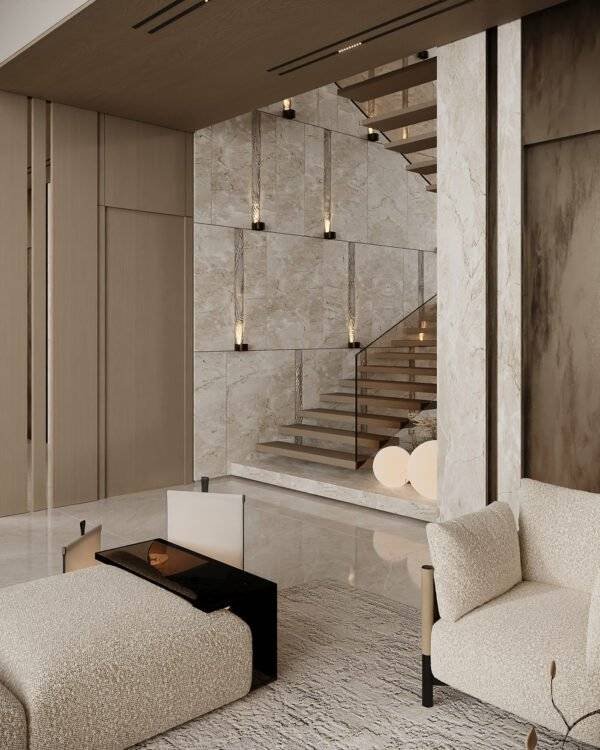
Where do you actually start?
The honest answer is: with the layout and the light, not with a mood board. Material choices are the easy part once the bones of a space are right. If the floor plan and the glazing don't work with how you actually use the house, no amount of travertine fixes that.
If you're planning a villa build or renovation for 2026 and want this approach applied to your own plot rather than a generic template, that's the conversation worth having early, before finishes get chosen in isolation.
At a glance
Fewer finishes, carried further. Three or four materials, repeated consistently, read as more considered than ten used sparingly.
Modern and Arabic-inspired design overlap more than people expect, especially through reworked screens and softened arches.
Glazing needs a heat strategy, not smaller windows: overhangs, external screens and shaded courtyards do the work.
The majlis usually stays separate even in an otherwise fully open-plan layout.
Community shapes appetite: Dubai Hills Estate skews fully modern, Al Barari skews biophilic, Tilal Al Ghaf and Arabian Ranches skew transitional.